
What If Rogue Black Hole Invades Galaxy?
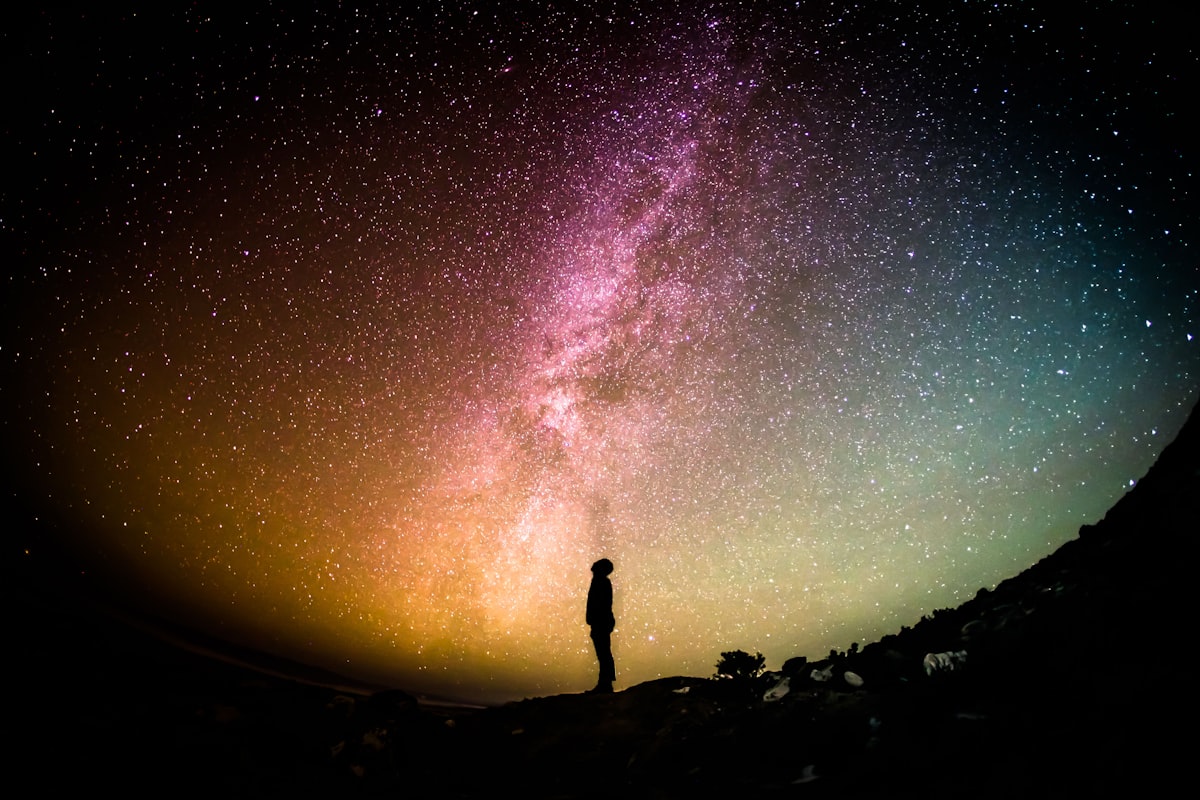
The sky unravels like a tapestry set aflame. A sickle of darkness cuts across the horizon, as if the universe itself has been slit open. Sensors tremble, detecting the faint whisper of distorted space-time. The stars shiver, their light dancing in erratic rhythms like fireflies on a summer night. The silence of space is oppressive, punctuated only by the creaks and groans of strained gravity.
A lone star on the horizon flickers, its radiance stuttering like a dying ember. The darkness deepens, a void that seems to be watching and waiting. The cosmos holds its breath as the very fabric of reality begins to unravel. In the distance, a faint, mournful whisper echoes through the expanse – the death knell of a thousand suns. The darkness stirs, a behemoth awakening from its slumber. The sky convulses, a mad tapestry of light and shadow, as the rogue black hole begins its merciless march across the galaxy, leaving in its wake a trail of shattered stars and civilizations teetering on the brink of eternal night. The universe trembles, poised on the cusp of an abyssal transformation.
The Cosmic Shift
SCENARIO DEFINITION: A rogue black hole, formed by the merger of two neutron stars, is traversing the Milky Way galaxy. This cosmic event is characterized by the black hole's immense gravitational influence, disturbing the stability of nearby star systems and triggering a chain reaction of supernovae. The laws of physics remain unchanged, but the black hole's presence alters the galaxy's dynamics. The solar system's structure remains intact, but the rogue black hole's gravitational wake disrupts the delicate balance of the galaxy's spiral arms. As it awakens dormant stellar nurseries, a cascade of supernovae ensues, illuminating the sky with an otherworldly glow. The black hole's trajectory poses a significant threat to the galaxy's equilibrium, potentially destabilizing the harmony of celestial mechanics and plunging regions into darkness. The cosmos unfolds with an air of deterministic chaos, as the rogue black hole orchestrates a celestial ballet of destruction and transformation.
The Observer's View
As the rogue black hole hurtles through the Milky Way, its presence becomes increasingly felt on Earth. At first, the effects are subtle, but they rapidly escalate into a catastrophic spectacle. The night sky transforms into a kaleidoscope of colors as stars and galaxies are distorted by the black hole's gravitational lensing. The moon appears to wobble in its orbit, and the sun's corona flickers with an otherworldly energy.
As the black hole draws closer, its gravitational influence begins to disrupt Earth's tides, causing massive flooding and unpredictable ocean currents. The atmosphere churns with unprecedented storms, as if the very fabric of the planet is being torn asunder. The gravitational waves emitted by the black hole create a low-frequency hum, felt as a vibration that resonates deep within the human body.
The skies fill with an eerie, pulsating glow as dormant stellar nurseries are triggered, giving birth to new stars and supernovae. The once-familiar constellations are now distorted, as if the celestial map has been rewritten. The rogue black hole's presence is a harbinger of doom, a reminder that the delicate balance of the galaxy is on the brink of collapse. As the darkness closes in, the air is filled with an unsettling, pungent scent, like ozone and smoke, a constant reminder of the impending catastrophe that threatens to engulf human civilization.
Universal Ripple Effects
As the rogue black hole careens through the Milky Way, its gravitational influence sets off a cascade of disruptions within planetary systems. The tides of nearby planets grow more turbulent, as if the very fabric of space-time has been stirred by an invisible spoon. Orbits become increasingly eccentric, causing climates to fluctuate wildly as the stability of axial tilts is compromised. Atmospheres, once tranquil and serene, begin to churn with unprecedented ferocity, as if the black hole's presence has awakened a slumbering beast. The consequences are far-reaching, with planetary inhabitants struggling to adapt to the new rhythms of their celestial environment. The once-predictable dance of the planets gives way to a chaotic waltz, as the black hole's gravity warps the harmonies of the galaxy.
The biosphere and life itself are not immune to the black hole's perturbations. As the sky transforms, with stars and constellations shifting like diamonds on black velvet, the natural world is forced to adapt to the new physics. The rhythm of day and night, the pulse of the seasons, and the migratory patterns of creatures all begin to falter. Humans, too, must confront the consequences of this altered reality, as their agricultural cycles, weather forecasting, and even their sense of time and space are turned upside down. The black hole's influence seeps into the collective psyche, inspiring a mix of awe, fear, and wonder. As the rules of the universe appear to bend and warp, the notion of a fixed and predictable cosmos gives way to a more fluid, dynamic, and mysterious reality. In this new landscape, life finds ways to persist, even thrive, as the boundaries between adaptation and evolution begin to blur.
The space infrastructure that underpins human civilization is also severely impacted by the rogue black hole's presence. Satellites, once orbiting with precision, begin to waver and stumble, their trajectories compromised by the black hole's warping of space-time. GPS systems, reliant on the stable geometry of the universe, start to falter, leaving navigation and communication networks in disarray. The International Space Station, a symbol of human ingenuity and cooperation, is forced to undergo emergency maneuvers to avoid the black hole's gravitational grasp. Moon bases, once envisioned as stepping stones for further exploration, are abandoned as the lunar orbit becomes increasingly unstable. As the black hole's influence spreads, the very fabric of space-based civilization begins to unravel, leaving humanity to confront the limitations of its technological prowess.
From deep space, the spectacle of the rogue black hole's rampage is a breathtaking, if unsettling, sight. The galaxy, once a tranquil, swirling disk of stars, is now a maelstrom of disrupted systems and exploding supernovae. The black hole's trail of destruction is a glowing, ethereal scar, as if the cosmos itself has been wounded. As the galaxy's spiral arms begin to destabilize, the delicate balance of gravitational forces is upset, threatening to plunge entire civilizations into an eternal, dark exile. And yet, even amidst this chaos, there is a beauty to behold – a reminder that the universe is a dynamic, ever-changing tapestry, woven from threads of gravity, light, and darkness. The rogue black hole, a harbinger of cosmic upheaval, serves as a poignant reminder of the awe-inspiring, if humbling, reality that lies just beyond the reaches of human understanding.
Frequently Asked Questions
What is a rogue black hole?
A rogue black hole is a black hole that has been ejected from its host galaxy
Would we survive if a rogue black hole invaded our galaxy?
Unlikely, as its gravitational pull would disrupt planetary orbits and cause widespread destruction
How are rogue black holes formed?
Rogue black holes can form from the merger of two neutron stars or the collapse of a massive star
Can we detect a rogue black hole approaching our galaxy?
Yes, astronomers can detect rogue black holes using gravitational wave observations and telescopes
Final Reflection
As the rogue black hole disappears into the cosmic horizon, its trail of devastation a reminder of the universe's unforgiving power, we're left to ponder humanity's tiny place within the grand tapestry. The delicate balance of our galaxy's spiral arms, once thought invincible, now seems fragile and ephemeral. The cosmos, in all its beauty, is a double-edged sword - capable of creating and destroying with equal ferocity. As we gaze up at the starry expanse, we're reminded of the universe's inherent unpredictability. And yet, it's in this uncertainty that we find our greatest inspiration. ThinkBeyondEarth: What other cosmic wonders, or threats, lie beyond our small blue planet, waiting to be discovered, and what is our place among the stars?



0 Comments