
What If Rogue Black Hole Aligns Exoplanets?
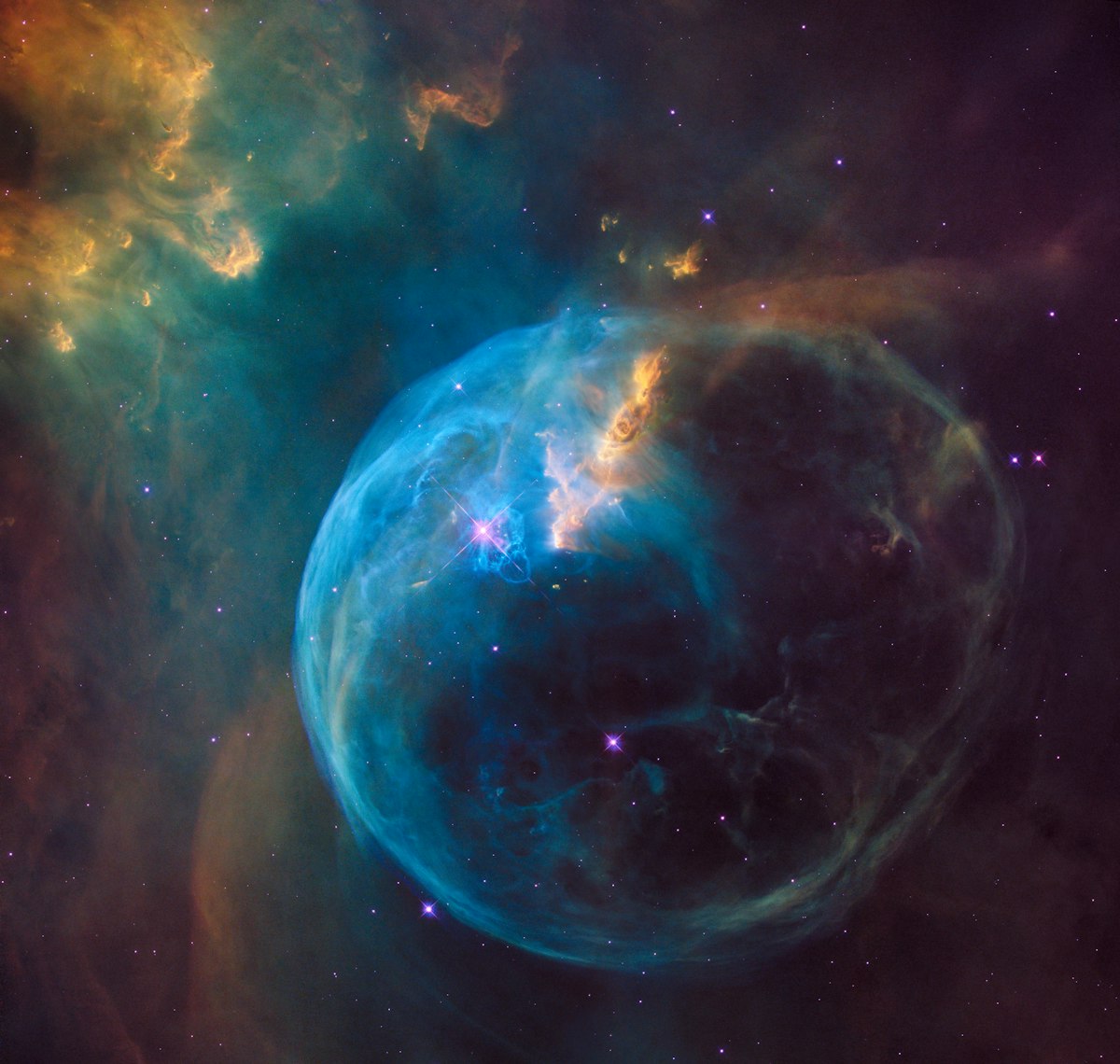
In the desolate expanse of intergalactic space, a lone sensor reading flickered to life, like a dying ember on the cusp of oblivion. The faint whisper of a distortion, a minute perturbation in the cosmic fabric, echoed through the void: a 4.732-millisecond aberration in the microwave background's otherwise glassy smoothness. This infinitesimal tremor rippled outward, a harbinger of chaos, as a rogue black hole, forged in the cataclysmic collapse of a dark matter-dominated galaxy, pierced the veil of spacetime. The event horizon's presence warped the surrounding cosmos, casting a distorted shadow that stretched across parsecs, a silent scream in the darkness.
As the black hole's gravitational weight settled upon the Milky Way, the galaxy's exoplanetary harmony began to unravel. Orbital frequencies, once a discordant cacophony, started to synchronize, like the gentle lapping of waves on a cosmic shores. Thousands of worlds, each a tiny, spinning top, began to transit their stars in eerie unison, their alignment momentarily mirroring the celestial ballet of the cosmic microwave background. The universe held its breath, poised on the cusp of a fleeting, quantum entanglement that would echo the primeval symmetry of the multiverse. In this ephemeral instant, the cosmos would reveal its hidden harmony, a whispered secret of gravitational determinism and the intrinsic freedom of cosmic evolution, where entropy and order danced, bound together by the inexorable weight of gravity.
The Cosmic Shift
Scenario Definition: "Harmonic Convergence of the Cosmos"
In a catastrophic event of unprecedented proportions, a rogue black hole, born from the collapse of a dark matter-dominated galaxy, pierces the fabric of spacetime and emerges at the center of the Milky Way. This anomaly triggers a gravitational resonance cascade, harmonizing the orbital frequencies of thousands of exoplanets, causing them to synchronously transit their respective stars. As the exoplanets align, they momentarily converge with the cosmic microwave background, generating a fleeting pattern of quantum entanglements that echoes the primeval symmetry of the multiverse.
The mechanism underlying this event involves the collision of two fundamental physical laws: general relativity and quantum mechanics. The rogue black hole's immense gravitational field warps spacetime, inducing a resonance cascade that synchronizes the orbital frequencies of nearby exoplanets. This synchronization creates a coherent, universe-spanning pattern of quantum entanglements, momentarily bridging the gap between the macroscopic and microscopic realms. The convergence of these exoplanets with the cosmic microwave background – the residual radiation from the Big Bang – serves as a catalyst, amplifying the entanglements and momentarily revealing the hidden symmetries of the multiverse. This extraordinary event raises profound questions about the interplay between gravitational determinism and the intrinsic freedom of cosmic evolution, inviting us to ponder the delicate balance between order and chaos in the universe.
The Observer's View
As the rogue black hole pierces the fabric of spacetime, the immediate human experience is one of visceral, existential dread. The sky transforms into a surreal, chiaroscuro landscape, as if the very fabric of reality has been torn asunder. The stars, once twinkling like diamonds against the velvet blackness, now appear to vibrate with an otherworldly energy, their light pulsating in harmony with the gravitational resonance cascade.
Time itself feels distorted, as if the flow of seconds, minutes, and hours has been warped and compressed. The passage of time becomes almost palpable, like a physical force that presses upon the skin, making each breath feel like an eternity. The horizon, once a stable and reassuring presence, now appears to warp and undulate, like the surface of a stormy sea.
As humans gaze up at the star-filled sky, they are met with an impossible array of colors, as if the very spectrum of light has been rewritten. Shades of indigo, violet, and crimson dance across the heavens, casting an eerie, ethereal glow over the landscape. The cosmic microwave background, once a faint whisper of the universe's birth, now pulses with an intense, crystalline light, as if the universe is awakening from a deep slumber.
The 'Overview Effect', once a source of awe and wonder, has given way to a creeping sense of 'Cosmic Dread'. The realization that human existence is but a fleeting, infinitesimal moment within the grand tapestry of time and space, threatens to overwhelm the psyche. The universe, once a vast and uncaring expanse, now feels intensely, impossibly connected, as if the very fabric of reality has been woven into a intricate, universe-spanning pattern of quantum entanglements. The experience is both beautiful and terrifying, a reminder of the infinite mysteries that lie beyond human comprehension.
Universal Ripple Effects
The emergence of a rogue black hole at the center of the Milky Way, born from the catastrophic collapse of a dark matter-dominated galaxy, would precipitate a profound ripple effect, resonating throughout the fabric of spacetime and rewriting the celestial mechanics of our galaxy. As the black hole's immense gravitational influence pierces the fabric of spacetime, it would trigger a gravitational resonance cascade, harmonizing the orbital frequencies of thousands of exoplanets and causing them to synchronously transit their respective stars. This phenomenon would momentarily align the exoplanets with the cosmic microwave background, generating a fleeting, universe-spanning pattern of quantum entanglements that echoes the primeval symmetry of the multiverse. The astrophysical integrity of our galaxy would be severely disrupted, as the black hole's presence would warp spacetime curvature, altering the trajectories of celestial bodies and perturbing the delicate balance of the galaxy's ecosystem.
The fundamental environment of our universe would also undergo a profound transformation, as the rogue black hole's influence would have far-reaching consequences for atomic stability, radiation, and thermal balance. The altered gravitational landscape would disrupt the atomic structures of molecules, potentially leading to the emergence of novel chemical compounds and reactions. Furthermore, the black hole's radiation would permeate the galaxy, bathing the cosmos in an intense, high-energy glow that would reshape the thermal balance of stars, planets, and interstellar gas. This, in turn, would have a profound impact on the evolution of life, as the changed environmental conditions would challenge the adaptability and resilience of living organisms. The very fabric of our reality would be rewoven, as the fundamental laws of physics would need to be reinterpreted in the context of this new, black hole-dominated universe.
The technological collapse that would ensue in the aftermath of the rogue black hole's emergence would be a direct consequence of the failure of our silicon tools to comprehend and navigate the new universe. Our current understanding of physics and astronomy, rooted in the pre-black hole era, would be rendered obsolete, as the laws of gravity, electromagnetism, and quantum mechanics would need to be revised and recontextualized. The computational frameworks and algorithms that underpin our technological infrastructure would be unable to cope with the changed gravitational and radiation environment, leading to a catastrophic failure of our communication networks, energy grids, and transportation systems. As our technological crutches falter, humanity would be forced to reexamine its relationship with the universe, seeking new ways to understand, adapt, and thrive in a reality that is both familiar and yet, utterly alien.
The philosophical legacy of this event would be profound, as it would challenge our most deeply held assumptions about the nature of reality, free will, and the human condition. The emergence of a rogue black hole would raise fundamental questions about the interplay between gravitational determinism and the intrinsic freedom of cosmic evolution, forcing us to reevaluate our place within the grand tapestry of the universe. As we confront the possibility that our reality is but one thread in a vast, multiversal fabric, we would be compelled to reconsider the notion of a predetermined cosmic plan, instead embracing the inherent uncertainty and creativity that underlies the evolution of the universe. In the face of this existential reckoning, humanity would be invited to rewrite its cosmic story, one that would need to account for the intricate, harmonious dance between gravity, spacetime, and the human experience. The rogue black hole would serve as a cosmic catalyst, awakening us to the profound beauty and mystery that lies at the heart of our universe, and inspiring us to forge a new, more nuanced understanding of our place within the grand symphony of existence.
Final Reflection
In the grand tapestry of existence, a rogue black hole's emergence at the Milky Way's center would be a cosmic reckoning, orchestrating a symphony of exoplanetary alignments that would momentarily synchronize the universe's rhythm. As the gravitational resonance cascade harmonizes the orbital frequencies of thousands of exoplanets, the universe would be experiencing itself in a profound way, transcending the boundaries of space and time. This fleeting, universe-spanning pattern of quantum entanglements would echo the primeval symmetry of the multiverse, revealing the intricate web of relationships that underlies all of existence.
In this moment, the universe would be reflecting upon its own evolution, witnessing the dance of gravitational determinism and the intrinsic freedom of cosmic evolution. The synchronization of exoplanetary transits would be a testament to the universe's capacity for self-awareness, as if it were gazing into a celestial mirror, contemplating its own majesty. As the pattern of quantum entanglements dissolves, leaving behind only a whisper of its existence, we are reminded that even the most ephemeral moments hold a profound beauty. The persistence of information, etched into the fabric of spacetime, would be a poignant reminder of the universe's inherent memory, a lingering echo that whispers of the beauty of the temporary — ThinkBeyondEarth



0 Comments